Investing as an expat: is your target in the right currency?
· 7 min read · Aurore
Say you moved from London to Singapore in 2016 and turned your target for retiring in the UK, GBP 750,000, into Singapore dollars. By the end of 2025, after putting SGD 4,500 a month into a fund tracking the S&P 500, you were 92% of the way to the pounds you need. Your Singapore-dollar figure said only 77%. So if you are investing as an expat, set your target and count your progress in the currency you will spend.
The two figures differ because the exchange rate moved: on the Federal Reserve's daily rates, a pound bought about SGD 2.09 at the end of 2015 and SGD 1.73 at the end of 2025. The mistake is converting the target once and never again: as soon as the rate moves, it no longer matches the pounds you need. If the fund grew 5% a year after inflation from here, the pound figure says you could stop working within about a year. The Singapore-dollar figure would keep you working for about three years.
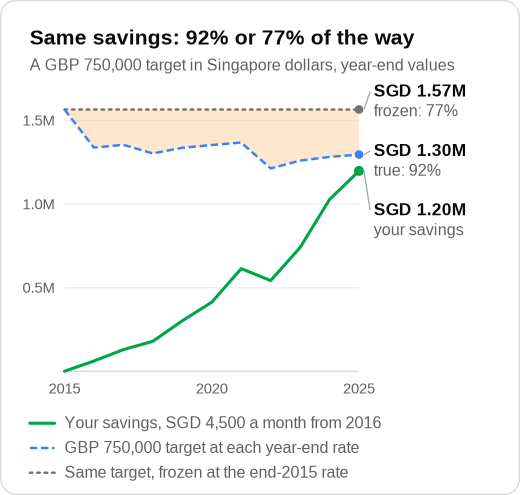
By the end of 2025 the savings have nearly reached the blue dashed line, the target that follows the rate. The frozen target stays at SGD 1.57 million, about a fifth more than GBP 750,000 cost at the end of 2025, and the shaded band between the two comes from the exchange rate alone.
Take someone in London putting GBP 12,000 a year into the same fund, to retire in Singapore on SGD 60,000 a year. For them the rate works the other way. Counted in pounds against a target converted from Singapore dollars in 2016, at the same 5% a year, they look about three years closer than they are.
The chart and the savers' figures are our calculation. Each year's saving goes in as one sum at the start of the year (SGD 54,000 for the first saver), converted at the Fed's daily rates for the Singapore dollar and the pound on the last business day before. The fund earns the S&P 500's yearly return with dividends reinvested, nominal and in US dollars, from the table of historical returns that Aswath Damodaran of NYU Stern updated on January 5, 2026, with no fees. Years left assume 5% a year after inflation from 2026, the same yearly saving in today's money, and end-2025 exchange rates.
These were good years for US shares: from 2016 to 2025, the fund returned about 14.7% a year in dollars. They were not smooth: in 2022 alone the fund lost 18%. And ten good years tell you nothing certain about the next ten. A weaker decade would have shrunk both counts, but the Singapore-dollar count would still sit about a sixth below the pound count and, on the same 5% assumption, about two years further from the target.
Where will you spend the money?
Your target is a multiple of what a year will cost you in the country you retire in, in its currency and at its prices. So moving changes the size of the target as well as its currency: a year in the UK and a year in Singapore cost two different amounts.
The usual multiple is 25, the same as a 4% withdrawal rate: the first saver's GBP 750,000 is 25 times GBP 30,000 a year. That 4% comes from William Bengen's 1994 study, which tested portfolios split evenly between US shares and US Treasury notes over retirements starting from 1926 on. It rests on US markets alone, so it promises nothing for a retirement in the UK or Singapore. How long it takes to reach financial independence turns that target into years.
Counting in the currency you earn can still work, on one condition: keep the target written in the currency you will spend, and convert it at the day's rate each time you check. That is the chart's blue dashed line.
What if you don't know where you'll retire?
Then your target can be split by currency, each part worked out from what you expect to spend in that country. Say you expect to spend half your retirement in the UK at GBP 30,000 a year and half in Singapore at SGD 60,000 a year: your target is half of each country's full target, GBP 375,000 plus SGD 750,000. Each part stays in its own currency, and you add them up at the day's rate each time you check. At the end-2025 rate that came to about GBP 809,000, and the first saver was 86% of the way there.
If you might move again, work the target out for each place you are considering and see how far apart the results are.
How far away is the day you'll start spending?
A day that is far off leaves the rate more years to move. At the end of 2022, on the same 5% assumption, the Singapore-dollar count put the first saver about 10 years from the target and the pound count about 7. By the end of 2025, with the pound partly recovered, the gap had shrunk to about two years.
From 2016 to 2025 the rate moved a long way, sometimes in a single day. A pound fell from about SGD 2.10 in January 2016 to about SGD 1.54 in September 2022, more than a quarter, and on June 24, 2016 alone it lost about 7%. A target kept in pounds needs no change on a day like that, but one converted into Singapore dollars is already out of date.
Your home market, where you live, or the US?
UK shares, for someone retiring in the UK, are valued in the currency the target is in, so no conversion stands between their value and the target. They also tie your money to one country's market. Shares where you live now, Singapore shares for the first saver, are in the currency of your pay, which matches your target only if you retire there. A fund tracking the S&P 500 owns US companies, so its value moves with the US dollar.
Over these ten years, the US dollar rose about 10% against the pound: for the first saver, a lift on top of the fund's return that pound assets did not get. For the London saver, who will spend Singapore dollars, home-market shares had the currency against them: the pound lost 17% against the Singapore dollar. That was one decade, and nobody can say which way the next will go.
The currency a fund's price is shown in does not settle which currency you hold. What the fund owns does. A fund holding US companies moves with the dollar even when your account shows its price in pounds, unless the fund hedges its currency (uses contracts that cancel out most of the exchange-rate move).
Tax depends on where you are resident and, for US citizens, on citizenship too: according to the IRS's Publication 54, revised in December 2025, US citizens living and working abroad are generally taxed on their worldwide income. For the rules where you live, start with that country's tax authority.
Counting in the currency you'll spend, in Firefly
Firefly, our financial independence tracker, lets you choose the currency you will spend as your display currency, out of 14 that include the pound, the euro and the Singapore, US, Canadian and Australian dollars. You add each holding in the currency it trades in. Firefly prices holdings on all major markets, and anything else goes in as a custom asset, kept in its own currency and valued at the price you paid. Then you set your target in your display currency.
Firefly values your portfolio on each day at that day's exchange rate, and a later move in the rate leaves those past values as they were. For the first saver, that is the pound count, redone at every day's rate, never a Singapore-dollar figure frozen in 2016. From your own return and monthly contribution, Firefly then works out the date your portfolio could reach the target, up to 50 years ahead, with a likely range. Next to that date, a bar shows how far along you are: set to pounds with a GBP 750,000 target, the first saver would have seen about 92% at the end of 2025, not 77%.
If your plans change, switch the display currency to the one you will spend in the new place: the target and monthly contribution are converted with it, and you can then set the target from what a year there will cost. A split target goes in as one figure, so redo the sum when the rate moves. Firefly's figures are nominal (inflation is not taken off), so raise your target by the inflation you expect before you stop working.
One thing to check this week
Find where your target is written down: a spreadsheet, a note, an app. Look at the currency next to it, then at the currency your rent will be paid in the year you stop working. If the two differ, only the target needs work. Work it out again from what a year there will cost, in that currency. Converting the old figure back is not enough: at the end-2025 rate, the first saver's Singapore-dollar target comes to about GBP 906,000, and the savings still look 77% of the way there. In Firefly, that means choosing the currency you will spend as your display currency and setting the new target in it.
General information, not financial advice. Drafted with AI and checked by a person.